Zapier is often the first tool people think of when somebody says "I need to automate something."
For 13 years it has connected thousands of cloud apps with no-code workflows. Today it powers more than 9,000 integrations, 66,000+ triggers and actions, and an AI governance layer for enterprises that needs to keep models, agents, and connections under control.
If your work lives entirely inside SaaS apps, Zapier can still be a sensible choice.
But a lot of real work does not live entirely inside SaaS apps. It lives on a desktop, in browser sessions that need a real login, in files on a local drive, in apps that do not have a public API.
That is where the comparison changes fast, and where MountainDesk becomes the stronger option.
This is not a "Zapier is bad" article. But it is a practical one: once automation moves beyond simple SaaS handoffs, MountainDesk covers more of the real work without extra tools, bridges, or compromises.
---
## What Each Platform Is Optimized For
### Zapier in One Sentence
A cloud-hosted automation platform that connects SaaS apps to each other through governed, audited workflows.
### MountainDesk in One Sentence
A local-first desktop control center that runs AI agents, browser automation, scheduled jobs, and visual flows on your own machine.
The difference is not features. It is where the work runs.
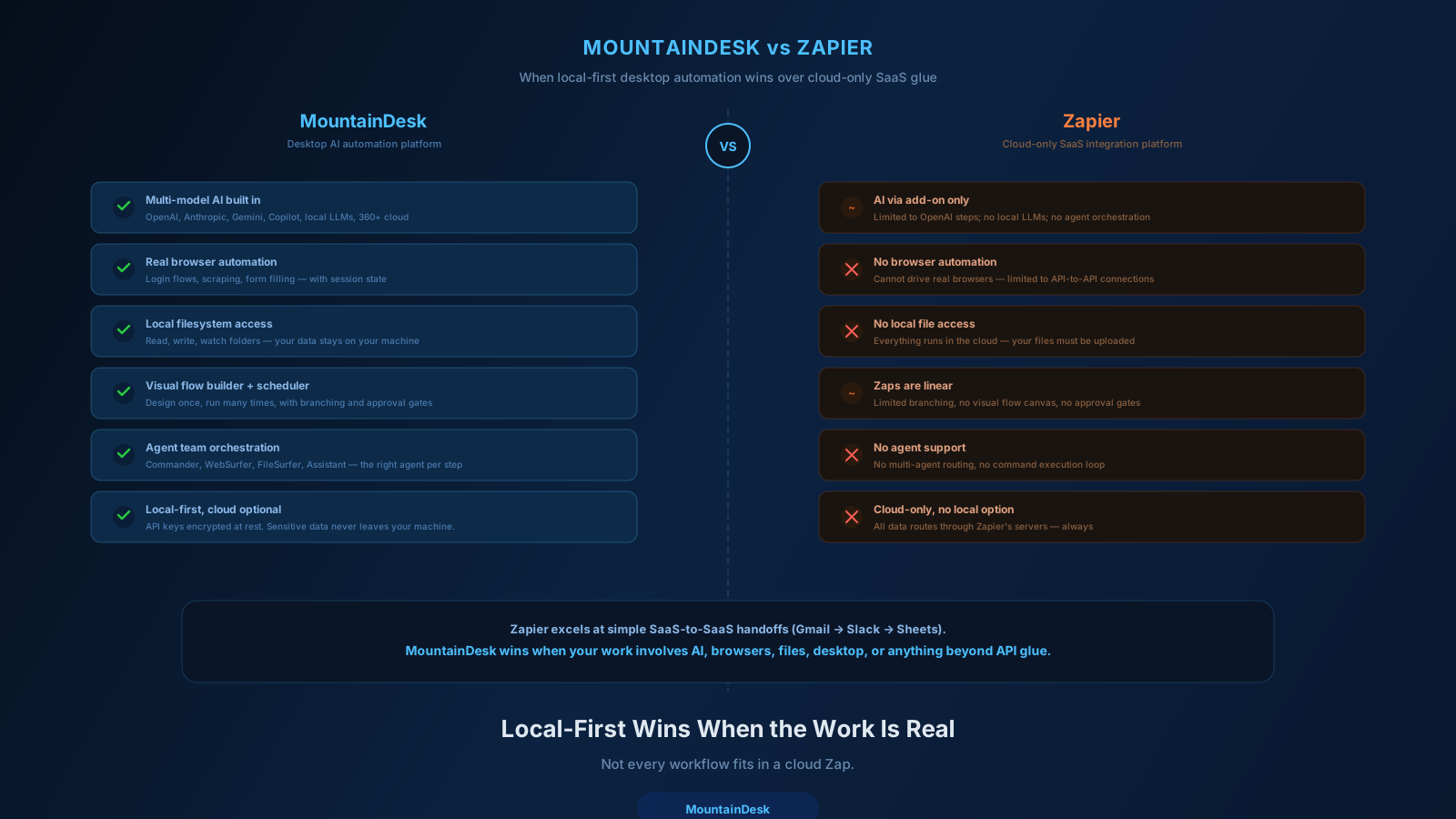
| | Zapier | MountainDesk |
|---|---|---|
| Where workflows execute | Zapier cloud | Your desktop (Windows / macOS) |
| Primary surface | SaaS app integrations | AI agents, browser, files, OS |
| AI model access | Connect external models | Built-in local LLMs + 360+ cloud models through MountainDesk Cloud |
| Browser automation | Extension-based, limited | Native commands (openurl, clicklink, fillfield, weblogin) |
| Local file access | None | First-class |
| Local LLMs | Not supported | Supported (Ollama, gemini-3-flash-preview, etc.) |
| Scheduled jobs | Yes (cloud cron) | Yes (desktop scheduler with model + agent selection) |
| Visual flow builder | Yes | Yes (with success/failure branches, retry, anchors) |
| Pricing model | Per task / per zap | Free tier + Pro €19 + Enterprise €49 |
| Data residency | Zapier cloud | Your machine, optional cloud sync |
Both are real automation platforms. They optimize for different shapes of work.
---
## Where Zapier Still Fits
Zapier has a place, but the scope is narrower than many teams assume. These are the cases where it still makes sense.
### 1. Pure SaaS-to-SaaS Plumbing
"When a row is added in Google Sheets, create a HubSpot deal and notify Slack."
Three SaaS apps. No local files. No browser session. No real AI reasoning required. That is the cleanest Zapier use case.
### 2. Mass Integration Coverage
9,000+ apps with maintained connectors is still Zapier's main advantage. If you need to integrate with a long-tail CRM, ticketing tool, or marketing platform, it will often have the connector already waiting.
### 3. Enterprise Governance for Distributed Teams
SOC 2 Type II, GDPR, CCPA, SCIM provisioning, action restrictions per app, log streaming to Datadog or Splunk. If you need a centralized cloud governance layer for lots of business users, Zapier is built for that conversation.
### 4. Truly Cloud-Native Workflows
Webhooks from one cloud service to another, with no human in the loop and no need for desktop or browser interaction.
If your work fits exactly these patterns, Zapier is fine. Outside of them, teams usually start running into the edges quickly.
---
## Where MountainDesk Pulls Ahead
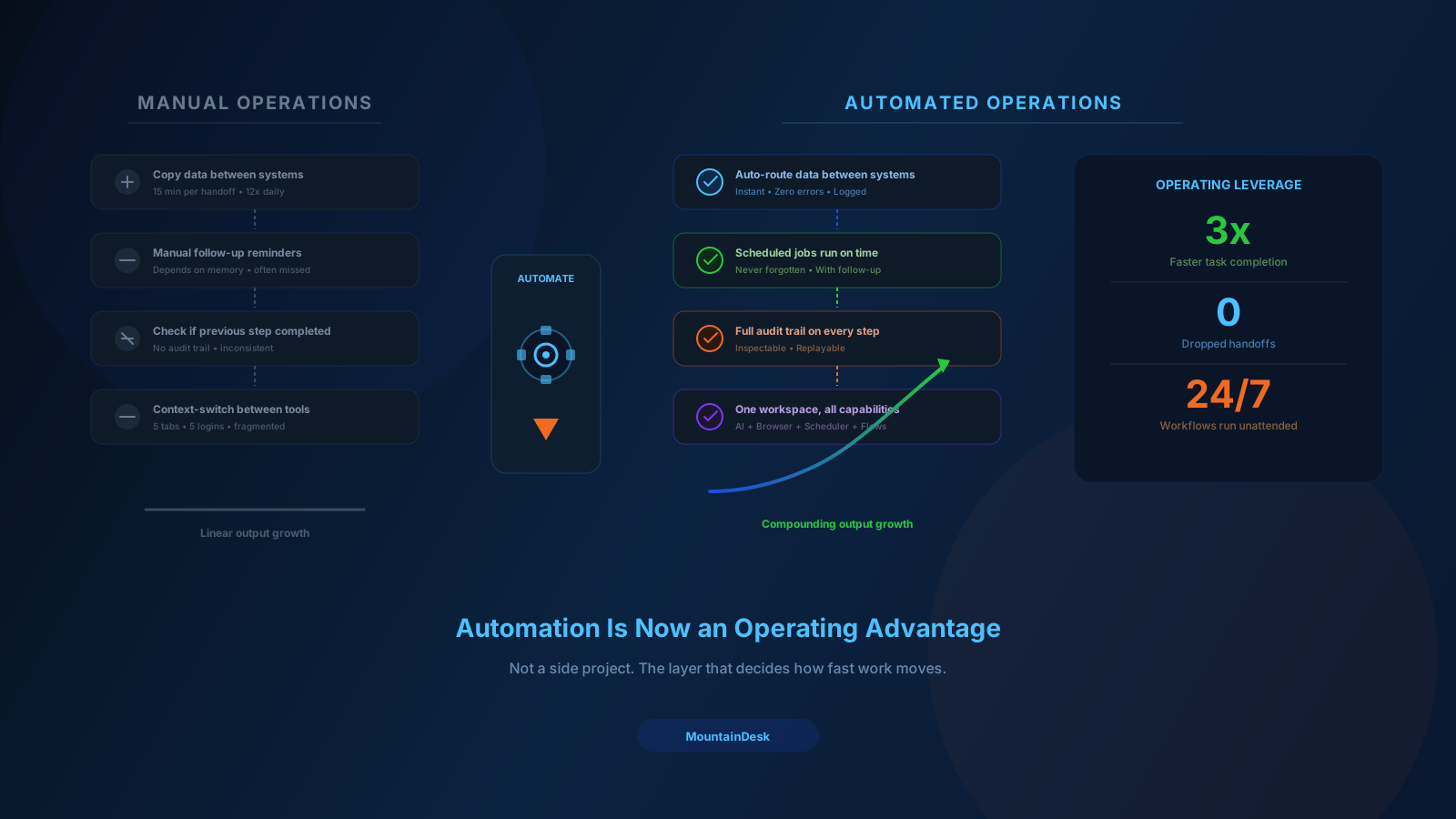
The more important shape of automation work in 2025-2026 is not simple API chaining. It is browser actions, file handling, AI orchestration, and local control. That is what MountainDesk is built for.
### 1. Anything That Touches a Real Browser With Real Login State
Zapier is great at API integrations. It is not great at "log in to this admin panel that has no public API, click through three pages, extract a table, and screenshot the result for compliance."
MountainDesk has built-in browser commands like openurl, clicklink, fillfield, and weblogin. The browser session lives on your machine, with your real cookies, sessions, and 2FA already in place.
This single capability replaces a large class of "we tried to automate this in Zapier and it broke the moment the workflow touched a real website" problems.
### 2. Workflows That Touch Local Files or the Operating System
Watch a folder. Move files. Read a CSV. Run a shell command. Open a desktop app.
These actions are first-class in MountainDesk through Ghost Mode triggers and the command execution loop. In Zapier, you usually end up bolting on a local agent, a webhook bridge, and extra glue code. At that point, you are paying more to recreate a weaker version of MountainDesk.
### 3. AI Work That Needs Multiple Models, Including Local Ones
Zapier connects to OpenAI, Anthropic, and others as cloud APIs. MountainDesk supports OpenAI, Anthropic, GitHub Copilot, plus local LLMs running on your machine through providers like Ollama (gemma, qwen, gpt-oss, gemini-3-flash-preview, and dozens more).
On top of that, MountainDesk Cloud gives operators access to 360+ managed models from one control plane. That matters because model routing stops being a procurement project. A team can test a fast Flash-class model for extraction, switch one node to a stronger reasoning model for edge cases, and keep the workflow in the same workspace instead of rewiring vendors.
For sensitive data — legal, medical, internal docs, anything that should not leave your network — being able to run local models inside the same workflow as cloud models is a meaningful capability difference, not just a checkbox.
### 4. Real Multi-Step Agent Orchestration
A "Zap" is fundamentally a trigger and a sequence of actions. Strong, but linear.
MountainDesk's agent orchestration assigns specialized agents (Assistant, Commander, FileSurfer, WebSurfer) to different parts of a workflow, runs a command execution loop where the AI's structured output is executed and fed back, and supports visual flow nodes with success and failure branches.
For multi-step reasoning work — research, analysis, drafting, reviewing — that is a fundamentally stronger paradigm than a linear Zap.
### 5. Cost Control on Heavy AI Workflows
Zapier's pricing is task-based. Heavy AI workflows running thousands of model calls a month rack up charges quickly across both Zapier tasks and the underlying model provider.
MountainDesk runs the orchestration locally. The only thing you pay for is the model provider directly (or use BYOK with managed cloud), with no per-task overhead on top of every step.
For AI-heavy workloads, the cost difference compounds fast, and MountainDesk stays predictable where per-task systems get expensive.
### 6. Data Residency and Privacy
Zapier executes in the Zapier cloud. That is fine for most SaaS data and is well-governed. It is not fine for everyone or every workflow.
MountainDesk is local-first by default. Cloud sync is opt-in. API keys are encrypted at rest. Sensitive workflows can be configured to never touch a third-party cloud at all. For many teams, that is not a nice-to-have. It is the deciding factor.
---
## A Practical Decision Framework
If you want the short version, choose MountainDesk unless your automation is truly just cloud app plumbing.
### Use Zapier when:
- The trigger and all actions live in cloud SaaS apps with public APIs.
- You need a long-tail integration that is already in the Zapier directory.
- Your CISO needs an enterprise governance plane across many teams.
- The workflow is fundamentally linear (trigger → actions).
- You do not need real browser sessions, local files, or local LLMs.
### Use MountainDesk when:
- The workflow touches a desktop, a real browser session, or local files.
- You want to run multiple AI models (including local ones) inside the same workflow.
- The work is multi-step and benefits from specialized agents.
- You need scheduled or event-driven background work that runs on a real machine.
- Cost or data residency rules out cloud-only execution.
- You want a recovery point (system state anchor) before running risky automation.
### Use both when:
- Lead lands via a Zapier-connected webhook → handed off to a MountainDesk flow that drives a real browser, runs local AI on sensitive content, and writes back to a SaaS via a Zap.
- This is actually a pretty common shape.
---
## A Side-by-Side Example: Daily Competitive Intel
Same workflow goal: every morning, check 5 competitor sites for changes and produce a summary.
### How You Would Build It in Zapier
1. Zapier scheduled trigger (daily at 7am).
2. Loop step calling a scraping service for each URL (separate paid tool).
3. AI step calling OpenAI with the scraped content (paid per model call).
4. Format step.
5. Slack message action.
Total: Zapier subscription + scraping tool subscription + OpenAI usage. Works, but you are stitching three vendors together and limited by what the scraping connector can do (no real browser sessions).
### How You Would Build It in MountainDesk
1. Scheduled job at 7am.
2. Visual flow with WebSurfer agent that opens each URL in the real browser (with whatever session state you have).
3. Commander agent compares yesterday's snapshot against today's.
4. Assistant agent drafts the summary.
5. Slack notification through built-in integration.
Total: MountainDesk subscription + your model provider (or local model = $0 marginal cost). One tool. Real browser. Optionally a local LLM for the comparison step.
The second approach is the one most serious automation teams actually want: shorter, cheaper at volume, and able to work inside real browser sessions instead of pretending every system has a clean API.
---
## What MountainDesk Does Not Try to Do
To be clear, MountainDesk is not trying to compete with Zapier on:
- Long-tail SaaS connector coverage (9,000+ apps is a multi-year build).
- Cloud-hosted enterprise governance for distributed business users.
- Codeless flows that a non-technical operations person can build entirely without thinking about local machines.
If those are your primary needs, Zapier may still be enough.
MountainDesk is trying to be the best place to run AI, browsers, files, and OS-level work as one orchestrated layer — which is exactly the part of automation Zapier is structurally not built for.
---
## A Note on Pricing
Zapier's full pricing depends on tasks per month, premium app access, and seats. AI-heavy use can scale costs quickly because every step is a billable task.
MountainDesk's pricing is simpler:
- Starter — Free. All AI models with BYOK, multi-model switching, agent system, scheduled jobs (limited), local-first.
- Professional — €19 / month. Unlimited AI messages and scheduled jobs, GitHub Copilot integration, cloud workspace sync, AI image generation, browser automation, Ghost Mode, MCP, Slack and Telegram, priority support.
- Enterprise — €49 / user / month. Shared cloud workspaces, SSO, audit logs, custom agent templates, WebSocket bridge, advanced scheduling pipelines, on-premise deployment support, SLA.
The flat-rate model means heavy AI usage does not scale your bill the way per-task pricing does.
---
## Final Takeaway
Zapier and MountainDesk overlap, but they are not equally capable.
Zapier is the integration plane for cloud SaaS apps. It does that one job well.
MountainDesk is the execution plane for AI, browser, files, and OS-level work on your own machine. It is purpose-built for the workflows modern teams actually struggle to automate.
For most operations teams in 2026, MountainDesk is the better primary automation platform because it handles the browser, desktop, file, and AI layers that create the most friction in real workflows. Zapier is best kept as a narrow add-on for simple SaaS connector tasks.
If your automation roadmap includes real browser sessions, local files, multi-model AI, or sensitive data that should stay on-machine, MountainDesk is the platform to evaluate first.
---
## Try MountainDesk Free
Local-first AI automation. Browser, files, schedules, agents, and visual flows in one workspace.
---
MountainDesk is the desktop AI automation platform for teams that need real browser, file, and OS-level execution alongside multi-model AI orchestration.